


Originally posted on Medium.
Panel discussion on Youtube
Often times when we think of teachers and policy, we think of them in isolation, one only affecting the other as an after thought. For us, teachers, it’s also much more comfortable to focus simply on teaching and stay away from policy because we all fear being too political. After all, it’s all about the kids, and politics and policy just get in the way of good teaching, right? Now, I’m not going to argue for educators to become activists or run for local office though it can’t hurt if some do, but as educators, we can’t shy away from policies that affect our students, and how we’re able or not able to teach them.
This past Wednesday, March 9, I was able to participate in a panel at SXSWedu and discuss policy. The panel was titled, “Straight Talk from Teachers on EdTech Policy”, moderated by former governor, Bev Perdue. I was accompanied by Kerry Gallagher and Matthew Worthington.
I arrived on Wednesday in Austin, and let me start by saying, that I should have gotten there on Monday. That was my bad, and am already planning for next year. I say this because going through the schedule I could see that I’d miss a lot of really cool sessions and workshops on virtual and augmented reality, EdTech, and Maker education. I did get to attend a panel titled: Can Hip Hop Save Us? I felt pleased that hip hop had been given a platform at the event. I actually appreciated the effort at diversity throughout the event.
I even saw Jose Vilson, author of This Is Not a Test, just hanging out. I had to approach him, and let him know I thought he was rock star. If you follows teachers on Twitter, you know Jose Vilson, especially if you follow #educolor. I didn’t say much because I didn’t want to interrupt his conversation, but walked away feeling like such a groupie/fanboy. To a certain degree, Vilson is one of my inspirations and role models for blogging and tweeting. Of course, I had to tweet about having seen him. I walked into the green room before my panel even more excited and pumped. I’d only even ever heard of green rooms from TV. I think I was expecting more snacks, but that’s just on TV, but it was nice to have somewhere to sit and wait.
The panel consisted of a Q&A session followed by a questions from the audience. Former governor, Bev Purdue, had a set of questions we had reviewed over the phone earlier to discuss throughout the session. Right away, I was impressed by my colleagues on the panel, and the ease with which they spoke about policy.

One of the issues we discussed was on access and equity. While I argued for the importance to provide access to equipment and technology within the schools, my colleagues added that not only should we be talking about access, but also equity. They brought up a good point about certain schools having state of the art technology that goes unused or underused because the staff hadn’t been trained properly or the technology was not rolled out adequately while there are schools doing a whole lot with the little technology they do have. This highlighted the importance of professional development for teachers and staff during the acquisition of new technology.
Another topic we looked at was data, and the growing concern in different districts with concern to data. We felt teachers were definitely concerned about privacy. I, however, feel that there are certain expectations to privacy that we automatically give up when we choose to participate in this modern society. In my community, many parents aren’t really that concerned about their children’s data. Perhaps, it’s because most of my school’s parents for better or worse have full trust in us, and what we are doing. Another reason is that being immigrants many of students’ parents just don’t feel they have any agency to push back or question anything the school does.
I have a love/hate relationship with data. As a math person, I love numbers and collecting data to find patterns. The problem is that some of the data teachers are asked to analyze is often times irrelevant and very abstract. In particular, having a score for an assessment where teachers are not aware of the question and how the student answered provides very little information. I also dislike data being used to evaluate teacher effectiveness. Doing so hinders creativity and experimentation on the part of administrators and teachers, which in turn means the teachers allow the students less creativity and experimentation.
Currently, I’m loving using programs to create my own assessments and forms in particular when those programs and forms can graph the results, so that I’m really enjoying collecting data, but the thing is that it’s my data. Teachers have access to tons of data, and if we are strategic we can begin to collect “smart data”. “Smart data” that aligns to our curriculum, instruction, and students’ needs.
For too long, we have been given the data by our districts, and many times, the data is reflective of student’s learning the previous year, and not even of the whole year, but of that one day on that one subject. We still need some form of data, so that instead of fighting against data, we would do better to guide the discussion towards smarter, timely, and relevant data. Technology definitely has a roll in the collection of this data.
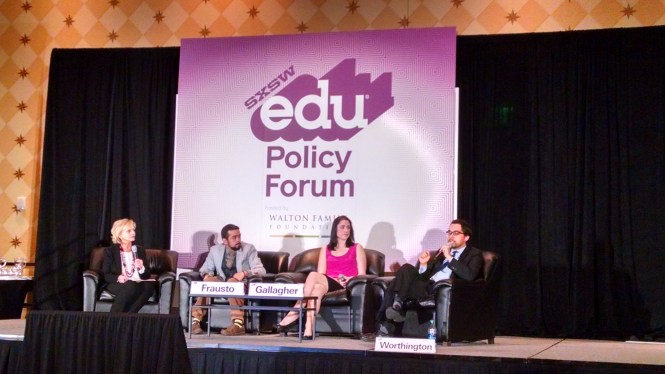
Another point, we made about the use of technology was about allowing students to use the tools of their times. Kerry mentioned how often times we look at school as preparation for the real world, forgetting that for our students, school is the real world. Matthew mentioned a student who was interested in film who sought out professionals to engage in the process of filmmaking, so that because of technology students can now seek out professionals in a given field for mentorship or collaboration.
This is what I feel is technology’s most important role. Our students need to be working with the tools and equipment that will be used once they are professionals. Also using these tools will give them an idea about whether or not it’ll be something that interests them as a career.
When I was in elementary school, I performed really well in Math, and competed. In eighth grade, I placed second in the whole city in the math portion of the city’s academic olympics, and teachers told me I should go into accounting, but why not computer science or programming. A lot of it had to do with the fact that my teachers weren’t teaching me with the tools of my time. Our computer lab was hardly ever used, and when it was, there was hardly any computer science happening.
The event ended, and I checked my Twitter account, @j053frau5t0, and retweeted all the awesome recaps from the panel. I headed back to my hotel, and to my surprise right after the panel, Jose Vilson tweets me back with “You should have said more tocayo,” which in Spanish is a term of endearment for someone with your same first name. Bonus. I replied that next time I would, which means I need to get on it, and look towards the next conference or the next panel. Geek heaven on Twitter for a moment.
I walked away from my panel very impressed and pleased with the whole process, and very excited to return, and maybe even hopefully stay for some of the music next time. Thank you to all involved in organizing the panel.
One last side note, everyone at the SXSWedu was quite aware that we were the nerd contingent of the whole SXSW madness, and as we, the nerds, departed all the real cool kids were beginning to arrive. I was surprised by the amount of roadies, and that even McDonalds was setting up a stage.

Originally posted in Medium.

For some, technology has made the world a smaller place and brought us closer together. For others, the gap between the haves and the have-nots has widened. Take technology in schools for example — students in certain schools, primarily where the poor and people of color reside, still lack access to the basic technology and tools they need to help them succeed in today’s world. A University of Chicago study has found that “at-risk” youth — including low socioeconomic students — in Chicago use technology less than other students. The same report also revealed that increased technology use was correlated with higher student outcomes.
As a student, I attended my neighborhood public school in Chicago and from a very early age, I felt the difference between the haves and the have-nots. Now, as a teacher in the same system, the gap has become even more apparent.
I grew up here and went to my neighborhood school. Like many public schools at the time that primarily served low-income students, there was very little technology in the building. My school had a computer lab equipped with 30 or so desktop computers, but it was only used by students who needed remediation. The first time I used a computer at school was during an after school class when the school decided the high-performing students needed technology exposure before high school.
In high school, all this changed. I went to Whitney Young High School — Chicago’s first magnet school. Suddenly, technology was everywhere. We had two computer labs, a TV production lab, and a media lab. It was an amazing transition. I felt empowered and trusted, like I was in control of where my future was going because I finally had the right tools at my fingertips. This is where my passion for education began, and part of what drove me to become a teacher. I knew — even back then – that if more students had this type of access and these experiences, it could be a game changer.
For the past 13 years, I’ve been teaching at Enrico Tonti Elementary School, a school that has the luxury of providing our students with technology, though not without effort. Many students at Enrico Tonti don’t have access to the level of technology required for future careers, so that the school has taken it upon itself to provide access to those tools. My students have access to so much more technology than I ever had and it has made a huge difference.
Our students are learning to use devices at a young age. In kindergarten, they learn how to handle the equipment, use QR codes, take screenshots, type, and even code. Eventually, students learn to create digital content and by fifth grade they design their own websites. Students use technology during the day to work on self-paced learning programs tailored to meet them at their specific level. The best part is how well this is working; in a survey we gave, nine out of ten students said that they pay more attention and focus better when using technology. This bodes well for their future careers.
Although we’ve come a long way since my time in elementary school — Enrico Tonti is proof — there’s still more we can and must do to narrow the gap. In a city where poverty and crime are so closely linked — where 2,995 people were shot in 2015 — we must find ways to educate youth who need it most. It’s the only way to bend the curve of systemic poverty and make our city safer and more prosperous.
Technology is not an end in and of itself and I certainly don’t think it’s the answer to all our educational problems. But we must be aware of the message we are sending to our students if we don’t address the barriers that currently exist. All students should have access to the types of devices and programs they’ll be expected to navigate as adults. If we don’t show them we trust them, who will?
As the politics around the future of Chicago Pubic Schools intensify and new deals and policies are discussed and negotiated, let’s be sure that we are not forgetting our city’s most vulnerable youth and that we do everything we can to equip them with the tools they desperately need to succeed. We’ve made some progress since my years as a student, but our work is not finished.

Originally posted in Medium.
of sorts…
Hello, I am Mr. Frausto and am very excited to be teaching in the computer lab and using the Internet a lot more in the classroom, especially to create a space on the Internet that extends what we do in the classroom out into the real world.
I have been teaching since September 2001, and have been teaching in Chicago since 2002. I love living in the neighborhood in which I work because it makes me feel extremely connected to my students and their families, especially since my family has lived in this neighborhood since October of 1994. I feel very connected to my students being a product of the Chicago public school system myself. I hope to inspire my students to establish goals and to then set in motion actions to achieve them. Having been very fortunate to have taken part of various diverse learning experiences myself, I hope to prepare my students to become active participants of an ever-evolving technological and multicultural world. I believe that it is important for students to be able to express themselves, their feelings, and thoughts. I hope this space is being created in my classroom, and now on the World Wide Web.
In my spare time, I enjoy reading and writing. Some of my interests include poetry, photography, video editing, music recording, web design, coding, traveling, and history.
from Tonti’s Computer Lab
i am me, a teacher, a po’ E.T, artivist, journalist, librarian.
short e aka 5ynthet1c m1t0515 of the lonely lost dark empties. a dreamer, a wanderer, a wonderer. still trying to find sense, crashing against spaces of the mind. not sure anymore about me or about u. it’s stopped making sense a long time ago, falling deeper into the rabbit hole. where am i again!?! what? never mind… don’t expect me to say anything. i came to watch. it’s too complicated. “who needs action when you got words.” “i’m a loser baby, so why don’t you…” and stuff.
i am just like you, with too many words inside my head, and too many ideas floating around, but i am just like you, regardless of what the voice inside my head may attempt to convince us of.
i can usually be found working with students, and when i am not, i am working on myself in my community with a pen and paper and a camera interacting with my laptop, a mic, garageband, a guitar, and a midi player…
in the future, where will we be? in the future, what will we be? i am po’E.T. today! tomorrow who knows?
and they say he spoke in two tongues, armed like two guns…
from urban po’E.Tree(s)
Well, I am currently a computer science/technology teacher who’s been writing poetry regularly since I was 12. What began as something I did at night, while hiding in my room, has turned into an obsession of sorts. Poetry is my therapy, joy, a home, a friend, a companion and partner in dialogue. I want to share this relationship with my students, and hope they also find a way to find their voice through poetry.
Compiled in these posts are poems created mostly by third through fifth grade students along with the process as to how assignments/activities are selected. Students have been members in the school’s Spoken Word club or have been a student at some point in one of my classes.
The official title of the club/class was “Spoken Word: Poetry, Raps, and Lyrics”, which is currently non-existent, but won’t be for long. I guess I will also post some of my poems, which I write specifically for the students of the Spoken Word club, my classes, and community.
I’m hoping that eventually this blog becomes a continuous conversation about poetry, in particular the poetry of children.
Breaking schemas
And
The molding of tomorrow’s youth
Into plastic soldiers
With replaceable, interchangeable personalities,
Guns, and names.
Marching away into the eve
Of tomorrow’s dawn,
Our
Children’s poetry
Will be
Bullets and gunshots ricocheting off the walls
That once supported dreams.
Left trying to decipher,
Marks on the wall,
Messages in graffiti,
If there was ever any
Meaning.
Cavemen left their marks on walls,
But these new scars relate misguided,
Disenchanted, disenfranchised urban youth-
Revenge on the concrete
Built on superficial ideals,
Wasted energy, fading hope, and savage inequalities.
Historians will remain in awe
At stains of blood,
Of murder filled books juxtaposed with fairy tales.
And these stories are yet to be recorded and written.
Depending on who dictates the future,
And how much everyone’s allowed to know,
They may never get written.
Thus the
Children’s poetry
Must not fall on
Or off
Deaf ears,
So that deviant behavior and memory
Will continue to remind
History,
And perhaps the whole conscious
Of present society,
Of those ignored, gentrified, and pushed to the outskirts
Until permeating the psyche.
Being that truth cannot be
Hidden or buried,
Children’s poetry
Will come out beating
To rhythms the color of love
That most people have already long forgotten.
Beatings and rhythms,
Washing out
The bitterness the present has left us.
Or maybe it’s just me that keeps hearing
The same thing,
The same song
That everyone’s been singing.
All the radio’s been playing.
Dewey would argue what the schools have been teaching
For centuries since the Romans and Greeks,
Or what corporate entities dictate through promoting.
Because
Nobody’s been listening,
Nobody is listening,
Nobody is listening
To the
Children’s poetry.
Cause what could they possibly teach anybody?
The
Children’s poetry,
Strange mutterings,
Frequencies,
But transmissions
Have had a tendency of being
Intercepted,
And thus the message has yet to be
Fully understood.
But children still believe in poetry.
Translating messages for history,
Some must start then decoding these writings and movements
Before an eternal silence befalls us all.
Trying to figure
Children’s poetry,
Already hiding in alleys,
Break dancing, and drawing on walls.
Trained to be just like little adults.
Learning quickly to bully and scheme,
How to politic and maneuver,
Aaaarrrggghhhhh.
Next comes the nervous breakdown.
Screaming, shouting, shooting in schools.
Wait.
It’s already happening.
Wait.
Because
Nobody’s been listening,
Nobody is listening,
Nobody is listening
To the
Children’s poetry.
Listening to the static off the vinyl
Interwoven into the grooves
Until foundations come down crumbling
Off the bass
From the
Children’s poetry.
Yelling to be recognized
As a single living identity, entity,
Independent of society’s standards and schemas
Of how children are supposed to be.
The whole of society seems bent and content with silencing
What echoes tremble in the voice of
Children’s poetry.
Dancing, running, playing, exploring, discovering
Without guides, barriers, or grown ups
At peace to develop like haiku:
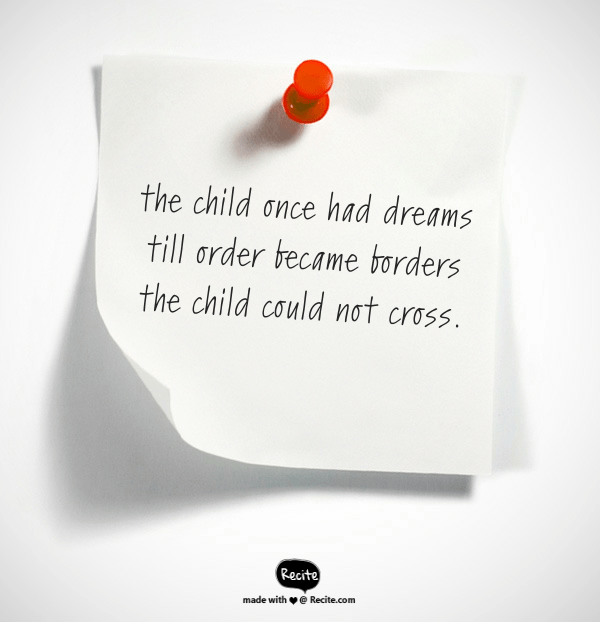
The child once had thoughts
Till order became borders
The child could not cross.
The child still has dreams,
But rules are raised up like walls.
Free the child in me.
Please.
Free the child in me.
Please. Free the child in me. Please.
Free the child in me.
Free the child in me.
Please. Free the child in me. Please.
Free the child in me.
9.24.04.
from spoken word: poetry, raps & lyrics.

wisdom means nothing on an island.
so isolated from the heart is the mind,
and if it takes more time,
well, i don’t really mind
as long as at the end, we get it right.
why are we in such a hurry?
always in such a rush?
to collapse and crash?
get it over with?
but there’s so much more to this,
so much more to this life of ours.
reach for stars and melt the bars.
live like lions instead of cowards.
free the earth. remove the chains.
expand your love. release the pain,
and start to look at everything
with new eyes. see through lies.
you realize time’s a device
to keep one occupied,
but there’s so much more to this.
there’s so much more to this.
wisdom means nothing on an island.
so isolated from the heart is the mind,
and if it takes more time,
well, i don’t really mind
as long as at the end, we get it right.
let’s do something that matters-
something that makes a difference.
let’s be that difference,
and bring about the change
we’ve been promised for so long
by politicians, pastors, preachers, ministers, and teachers.
bob dylan said it’d be blowing in the wind
for the times, they are changing.
and once we were slaves, now we are free.
once were the subjects, now let’s run these schools,
and educate ourselves to learn-
not to be assessed in order to pass
when life’s the most important test,
which can only be assessed
and evaluated through our collective happiness.
please excuse my arrogance.
please excuse my arrogance.
wisdom means nothing on an island.
so isolated from the heart is the mind,
and if it takes more time,
well, i don’t really mind
as long as at the end, we get it right.
07.30.14.
i’m the rock and the hard place,
so all be damned
when we blindly follow along
just to get on,
just to get by-
choose to live a lie
haunted by an eternal question:
why?
writing is easy,
but singing is hard.
let me put all of my words within a box.
i hope you let me fill it all up with all of my dreams
within these four walls,
so we can create our own universe.
you know we can imagine a different way. a better way
that would be our own.
we think we’re so grown,
but still act like little kids-
afraid of forming opinions
for fear of opposing ones.
when i was 16,
i used to be so angry.
who am i kidding?
i’m still fucking angry.
but i don’t want to be so angry
for the rest of my life.
i got a son who means the world,
deserves the world, and with a fucking smile
even when i’m not feeling up to it.
he deserves the best of whatever world we can invent.
try to battle out all of my demons,
so as to not have to repeat them,
or transmit them to him.
i want him to be free of all of my emotional baggage.
i don’t want society to place limits for him-
for how high the ceiling should be,
but then neither should I.
i mean i gotta try
to see the light,
and make the world bright
with illuminated sentences and phrases.
i mean i’m not that little kid anymore,
and the weight of my past should not burden me.
if i’m to become the type of parent i want to be,
i can’t be
of the lonely lost dark empty anymore.
i’ve got friends, a son, and wife,
and soon we’ll have a daughter.
i’m not so lonely anymore,
or even lost.
perhaps a bit out of touch,
but it’s not so dark
inside of my heart.
some space’s opened up,
and it’s growing each day.
07.16.14.
mira, mira como cai,
el pueblo se tira,
y la mentira se estira.
la mentira se estira.
aquí no habra espacio
pa’ que existan
todos los pueblos
siempre unidos?
a que este mundo tan confundido.
queremos vivir en paz,
pero con tantas guerras-
pues ya no se puede.
y donde cabremos
dentro de este sistema sin frenos?
en donde acabaremos
si nunca se nos ha tomado en cuenta
cuando las leyes se escriben
y se las inventan?
mira, mira como cai,
el pueblo se tira,
y la mentira se estira.
la mentira se estira.
yo no llegue,
a mi me trajieron para acá,
y yo no escoji en donde nací.
soy ciudadano del mundo.
yo decido
como me identifico,
en que idioma me explico,
y con que lengua describo
a el universo que exploro
al soñar y al despertar.
al soñar y al despertar
salgo siempre a navegar
con un plumón y mil palabras
traigo ojos como una cámara
para no olvidar.
para ya no olvidar.
mira, mira como cai,
el pueblo se tira,
y la mentira se estira.
la mentira se estira.
07.09.14.
listen to the track here on soundcloud.
translation:
look, look how it falls,
the people cower,
and the lie stretches itself.
the lie stretches out.
there must not be room here
for all of the people
to exist
always united?
oh what a world, so confused.
we want to live in peace,
but with so many wars-
well, we can’t anymore.
and where will we fit
within this system without brakes?
where will we end
if we’ve never been taken into account
when the laws are written
and they get invented?
look, look how it falls,
the people cower,
and the lie stretches itself.
the lie stretches out.
i didn’t come,
they brought me here,
and i didn’t choose where i was born.
i am a citizen of the world.
i decide
How i identify myself,
in which language i explain myself,
and with what tongue i describe
the universe, which i explore
while i’m dreaming and awake.
while i’m dreaming and awake,
i go out and navigate
with a pen and a thousand words,
with my eyes like a camera,
so i don’t forget.
so i won’t now forget.
look, look how it falls,
the people cower,
and the lie stretches itself.
the lie stretches out.
translated 07.15.14.
current mantra.



¿quien se acuerda cuando fuimos?
¿quien se acuerda lo que fuimos?
¿lo que somos?
¿seguiremos siendo?
como una ola del mar,
ó una piedra rolando
que en el camino se encuentra.
como una brisa del viento,
una caricia y un beso
del planeta y universo,
un instante y un momento
pues es lo mismo
si nuestro amor es eterno.
tu me quieres.
yo te quiero.
yo te amo.
tu me amas,
y como pájaros, los dos,
brotamos alas
para no enredarnos
entre las ramas
de nuestro jardín.
hasta convertirnos
en oxigeno para los dos
para sobrevivir,
para poder existir.
sin ti yo no quiero seguir.
tu me tienes.
yo te tengo,
y así vamos andar
como unas olas del mar
ó piedras rolando
que en el camino se encontraron.
¿quien se acuerda cuando fuimos?
¿quien se acuerda lo que fuimos?
cuando lo que somos,
seguiremos siendo
es lo único que importa.
y nuestra pequeña familia.
07.02.14.
who remembers when we were?
who remembers what we were?
what we are?
will continue being?
like a wave from the sea,
or a rolling stone
that on the journey is found.
like a breeze from the wind,
a caress and a kiss
from the planet and universe,
an instant and a moment
well it’s the same thing
if our love is eternal.
you want me.
i want you.
i love you.
you love me,
and like birds, both of us,
grow out wings
so as to no become entangled
amongst the vines
of our garden.
until we become
oxygen for both of us
to survive,
to be able to exist.
without you i don’t want to go on.
you have me.
i have you,
and that’s how we’ll go on
like waves from the sea
or rolling stones
that on the journey found each other.
who remembers when we were?
who remembers what we were?
when what we are,
will continue being
is the only thing that matters.
and our little family.
translated 07.15.14.
 UP!::urban po'E.Tree(s)